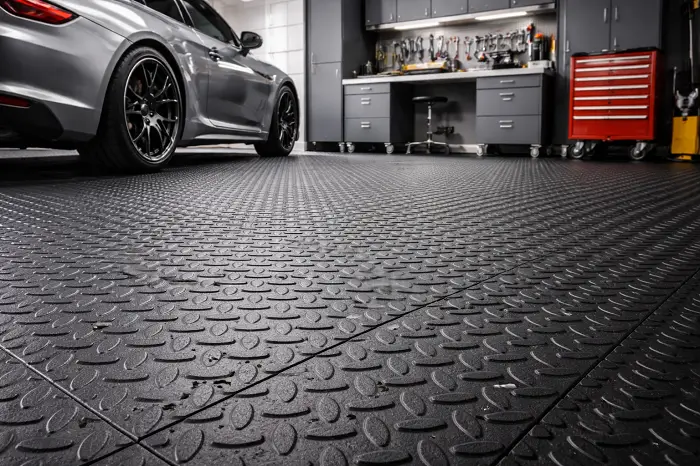
Car parked in a UAE villa garage on a dark grey garage floor

Garage Flooring in Dubai, Abu Dhabi and Across the UAE

Garage flooring is a floor system fitted over a garage slab to handle vehicle weight and the conditions a garage puts on it: heat, tyre wear, dust and spills. In Dubai that is usually a resin coating bonded to ground and primed concrete, or a loose-laid tile system. Ten systems are in common use, and the right one depends on how the garage is used.

  • Installing across the UAE since 2014
  • All 7 emirates covered
  • 10 garage floor systems compared
  • Free site visit and measurement
  • Same-day response in Dubai and Abu Dhabi

Which garage flooring system suits your Dubai garage?

The best garage floor system depends on how the garage is used, not on which coating is toughest on paper. Three things decide it: whether a car is parked daily or the space doubles as a workshop, how much grip the floor needs when wet, and how long the garage can stay out of use while the floor cures. The table below compares all ten systems on those terms.

Buyers usually arrive looking for one answer and leave with a shortlist of two. The honest version of the question is narrower than "what are the types of garage flooring". It is whether you want a coating bonded to the slab, which means grinding, a cure period and a floor that behaves as one surface, or a loose-laid tile system, which goes down in a day, lifts out again and lets water and dirt through the joints. Everything else is a choice inside those two families.

Ten garage floor systems compared. Price bands are indicative; the figure for your garage is confirmed on the free site visit.
Flooring systemPrice (AED/sqm)Best forDurabilityStyleDetails
Interlocking tiles50-130 AED/sqmDIY install, quick swap10 to 15 yearsFunctional, modularInterlocking garage flooring
PVC tiles50-130 AED/sqmAuto workshops, chemical zones8 to 12 yearsHard, smooth, industrialPVC garage flooring
Rubber tiles55-250 AED/sqmGyms, sound dampening10 to 15 yearsCushioned, softRubber garage flooring
Standard epoxy65-250 AED/sqmBudget homes, solid colour10 to 15 yearsSolid colour, glossyEpoxy garage flooring
Garage chips65-130 AED/sqmSubtle decoration12 to 15 yearsSpeckled, multi-colourGarage chips flooring
Garage flakes85-180 AED/sqmHeavy-duty, decorative15 to 20 yearsBold flakes, showroom-gradeGarage flakes flooring
Polyurethane95-200 AED/sqmDirect sun, active garage18 to 22 yearsSolid premium, satin finishPolyurethane garage flooring
Polyurea120-280 AED/sqm24-hour cure, fleet bays20 to 25 yearsSolid premium, high-glossPolyurea garage coating
Microcement200-500 AED/sqmLuxury homes, jointless look15 to 20 yearsJointless, artisanalMicrocement flooring
Metallic epoxy250-600 AED/sqmShowrooms, luxury villas15 to 25 yearsMarble swirl, mirror finishMetallic epoxy flooring

Garage flooring systems we install across the UAE

Ten of these are in the comparison table above. The eleventh, workshop and industrial, is a heavier build specified per bay rather than a catalogue system, so it is described here and not compared on price.

Glossy solid colour epoxy garage floor in a UAE residential garage

Epoxy resin coating

A solid colour resin coat bonded to ground and primed concrete. Lowest entry cost of the resin systems and simple to clean, which suits a family garage used for parking rather than work. It needs a cure period before a car goes back on it.

Epoxy garage flooring
Decorative flake epoxy garage floor in a UAE villa with a multi-colour flake blend

Epoxy flake broadcast

Coloured vinyl flakes scattered into the wet resin, then sealed. The flake texture gives grip underfoot and hides tyre marks and minor slab repairs better than a flat colour. The usual answer where a smooth floor would be too slippery around a wet car.

Garage flakes flooring
Quartz chip garage floor laid at full coverage in a workshop bay

Decorative chip blend

A heavier, larger chip laid at full coverage for a terrazzo-like finish. Chosen for showroom bays and villa garages where the floor is on display. It costs more to lay than flake because the chip load and the sanding stage are both greater.

Garage chips flooring
Mirror-finish metallic epoxy garage floor with a blue and silver marble swirl

Metallic epoxy finish

A pigmented metallic resin that moves while curing to give a marbled depth. A display finish for a showroom or a car collection rather than a workshop floor. It shows scratching sooner than a flake system under daily tyre traffic.

Metallic epoxy flooring
Glossy polyurethane garage floor in a UAE multi-level parking facility

Polyurethane (PU) topcoat

A tougher, more flexible resin than epoxy, laid as a full system or as a topcoat over one. It holds colour better under UV and sunlight, so it suits a garage with an open door or an exposed bay, and it cures faster than epoxy.

Polyurethane garage flooring
Spray-applied polyurea garage coating with a gloss finish

Polyurea coating

A fast-curing resin, often laid with a polyaspartic topcoat, that returns a garage to use in about a day rather than several. The choice when downtime is the real constraint. It needs skilled application because the working time is short.

Polyurea garage coating
Black and grey interlocking garage floor tiles in a Dubai garage

Interlocking tiles

Rigid tiles that clip together over an existing slab with no bonding, no grinding and no cure time. Removable, so they suit a rented villa or a garage that cannot be taken out of use. Dirt and water pass between the joints.

Interlocking garage flooring
Black and red chequered PVC garage floor tiles in a Dubai villa

PVC tiles

Flexible PVC tiles, perforated or solid, laid loose over concrete. Softer underfoot than rigid tile and quick to lift and wash. Less suited to point loads such as a jack foot or a trolley leg, which can mark the surface.

PVC garage flooring
Textured heavy-duty rubber garage floor tiles in a UAE workshop

Rubber tiles and rolls

Dense rubber in tile or roll form, laid over the slab. It absorbs impact and sound, which suits a garage used as a home gym as much as a car space. Tyre contact over time can mark lighter colours.

Rubber garage flooring
Microcement floor with a smooth stone-like finish

Microcement, decorative only

A thin cement-based coat with a stone-like finish, used mainly on interior floors, walls and surfaces. It is listed here for comparison rather than as a garage system, because a parking bay asks more of a floor than microcement is made for.

Microcement flooring
Heavy-duty resin floor in a UAE mechanical workshop bay

Heavy-duty workshop systems

A thicker resin build, usually with a quartz or aggregate broadcast, for bays where a vehicle is worked on rather than parked. Specified around point loads, dropped tools and standing fluids. Grip level and fall to drain are set on site.

Workshop flooring

What decides the cost of a garage floor in Dubai

Nobody can price a garage floor from an area figure alone, and the quotes that arrive by WhatsApp within the hour are guesses. Four things move the number, and the first one is the one buyers never expect.

The slab decides more than the system does

A sound slab needs grinding and priming before a coating goes down. A slab that has been parked on for fifteen years usually needs more than that: oil driven into the surface has to be ground out, cracks and spalling have to be filled, and a slab with moisture coming up through it needs a barrier primer before anything else. That preparation can cost more than the coating. It is also the stage that decides whether the floor lasts, so it is the wrong place to save money.

System choice moves the band, not the whole price

A loose-laid tile floor and a solid colour epoxy sit close together. A metallic or full-chip finish sits well above both, because the material cost and the labour both rise. The comparison table above shows where each system sits relative to the others.

Area alone does not give a figure

Two garages of the same size price differently if one has a drain to fall to, a step to detail, a column to cut around or a door that has to stay usable while the floor cures. Edge work and detailing is where the hours go.

What the free site visit measures

Slab condition and moisture, the real area including edges and thresholds, how the space is used, sun exposure through the door, and whether the garage can be taken out of use for the cure. That produces a written figure rather than a range, and the quote follows within 24 hours.

Why garage floors fail in UAE heat, and what prevents it

Most garage floors that fail in the UAE fail for one of four reasons, and three of them are avoidable at the specification stage.

Hot tyre pickup, and which systems resist it

A tyre that has been on Dubai tarmac holds heat for a long time after the car is parked. Where a coating is thin, poorly bonded or cured too soon, that heat softens it and the tyre lifts patches of the floor away as the car pulls out. Thicker resin builds, correct primer and a full cure before the first vehicle goes on resist it better than a thin paint film, and polyurethane and polyurea hold up better than standard epoxy. No coating is immune to it.

Slip when the floor is wet

Oil, water and tyre dust can make a smooth garage floor slippery, so we add flake or anti-slip aggregate to give grip where needed. The level is set on the site visit, not chosen from a brochure, because a workshop bay that gets washed down needs more grip than a dry villa garage and too much texture makes a floor harder to sweep.

An oil-soaked slab, and what it needs first

Oil that has soaked into concrete stops a coating bonding to it, and a coating that has not bonded will lift whatever is laid on top. A contaminated slab needs grinding back and, where the contamination is deep, degreasing and a barrier primer before any resin goes down. A coating lasts only on a ground and primed slab. Where the slab is too far gone for that, tiles over the existing concrete are the better answer.

UV, heat and colour change

Standard epoxy yellows and chalks where strong sunlight reaches it, which happens in any garage with the door open through the day or an exposed bay. Polyurethane and aliphatic polyurea hold their colour better under UV. For a closed, shaded garage it is not a factor worth paying for.

How we install a garage floor, the five stages

Most garage floors that fail trace back to the second stage rather than the coating. Preparation decides whether a resin system bonds, and a bonded system laid on a sound slab outlasts a better product laid on a dusty one. The five stages below are in order, and the second takes the longest.

  1. Free on-site inspection. Slab condition, moisture, real area, how the space is used and sun exposure. Same day in Dubai and Abu Dhabi, within 24 to 48 hours elsewhere. Written quote within 24 hours.
  2. Substrate preparation. Diamond grinding to open the concrete, then crack and spall repair, degreasing where oil has soaked in, and a barrier primer where moisture is coming up through the slab. This is the stage that decides the outcome.
  3. System application. The chosen system laid to the manufacturer's mixing ratios, thickness and coat timing, with grip level and fall to drain set as specified on the visit.
  4. Quality inspection. Coverage, thickness, edge and threshold detailing, and cure state checked before anything goes back on the floor.
  5. Handover and maintenance guidance. Cure time confirmed in writing before vehicle traffic: 24 to 72 hours for epoxy, about 24 hours for polyurethane and polyurea, immediate for tiles. Plus how to clean it and what to keep off it.

EN ISO 2812, how to check liquid resistance

Garage floors meet petrol, brake fluid, engine oil, coolant and screen wash, and a supplier who says a coating is "chemical resistant" has told you nothing. EN ISO 2812 is the published standard that covers the resistance of paints and coatings to liquids, and knowing how it works lets you ask a question that cannot be answered vaguely.

The test works by exposing a coated panel to a specific liquid for a specific time, by immersion or by holding the liquid against the surface under a cover, then examining the panel for softening, swelling, blistering, colour change and loss of adhesion. The result is only ever a result for that liquid at that exposure time. Resistance to water says nothing about resistance to brake fluid, and a thirty-minute exposure says nothing about a spill left over a weekend.

So the question to ask any supplier is: which liquids was this coating tested against, and for how long. If the answer does not name both, there is no test behind the claim.

We do not hold a test document in this name for our own floors.

Garage floor system limits and what we fit instead

Five situations where we would not fit the obvious thing.

Floor paint, and why we do not sell it

A one-part floor paint is the cheapest thing that can go on a garage slab and it is far less durable than a resin system, wearing through under tyres within a year or two where a resin floor lasts a decade. If the budget only reaches paint, the honest advice is to wait and do it once. We fit the resin systems in the table instead.

A garage that cannot be taken out of use

Every bonded resin system needs the floor empty through grinding, laying and cure. Where that is not possible, a rented villa, a single-car household, a workshop that cannot close, interlocking tiles go down over the existing slab in a day with no cure time and lift out again later.

Parking tonight

Epoxy needs a cure period before a vehicle is parked on it and there is no way to shorten it safely. Where the car has to be back in by the next day, polyurea returns the garage to use in about 24 hours and polyurethane cures faster than epoxy.

A floor that gets washed down

Smooth epoxy is a poor choice where water sits regularly. Epoxy flake or an aggregate broadcast gives texture that holds grip when wet, specified at the level the bay actually needs.

A decorative finish in the wrong place

Microcement is made for interior floors and walls, not for a parking bay taking vehicle weight and hot tyres. Where the look is the priority and the space is a showroom rather than a working garage, it is the right product in the right room. For a garage we fit metallic epoxy or a decorative chip blend instead.

Garage flooring coverage across all 7 UAE emirates

We install across every UAE emirate. Dubai and Abu Dhabi carry same-day site inspection, and most of the work is residential villa garages, basement parking bays and commercial workshops across both. Al Ain is covered as a city within Abu Dhabi emirate.

Sharjah, Ajman, Umm Al Quwain, Ras Al Khaimah and Fujairah are scheduled within 24 to 48 hours of the enquiry rather than same day, because the visit is routed with other work in the emirate. Covered parking in apartment buildings and villa garages make up most of it.

Multi-bay and basement parking flooring is specified differently from a single villa garage: traffic volume, fall to drains, line marking and the sequence that keeps part of the car park open while the rest is laid. Tell us how many bays and whether the park can be closed in sections, and the visit is planned around it.

Recent garage flooring projects across the UAE

Epoxy basement parking floor in a Business Bay office tower, Dubai

Epoxy basement parking, Business Bay, Dubai

An office tower basement with daily tenant traffic and no window for a full closure. Laid in sections so half the bays stayed open throughout, with bay lines reinstated over the new floor and fall to the existing drains kept.

High-gloss marbled resin showroom floor in Al Bateen, Abu Dhabi

Microcement showroom floor, Al Bateen, Abu Dhabi

A premium retail showroom where the floor is part of the display rather than a working surface. Finished to a stone-like matt and sealed, with the joint lines in the existing screed detailed out so the floor reads as one surface.

Polyurethane basement parking floor in a Downtown Dubai apartment building

Polyurethane basement parking, Downtown Dubai

A residential building with an exposed ramp and bays that take direct sun through the opening. Polyurethane chosen over epoxy for colour hold under UV, with grip raised on the ramp where water runs down it after washing.

Interlocking PVC garage tiles in a villa in Al Jurf, Ajman

Interlocking PVC tiles, villa in Al Jurf, Ajman

A private villa where the owner wanted the floor changed without the garage being closed for a cure. Tiles clipped down over the existing slab in a day, with cut tiles detailed around the threshold and the door track left clear.

Heavy-duty mall parking floor in a Dubai Marina shopping centre

Heavy-duty mall parking, Dubai Marina

A shopping centre car park with trolley wheels, delivery traffic and bays that could not all close at once. A thicker build with aggregate broadcast for grip, phased so trading was not interrupted.

Speckled flake garage floor in a residential villa in Al Barsha, Dubai

Rubber tile home garage, Al Barsha, Dubai

A villa garage used as a home gym as much as a car space. Dense rubber tile for impact and sound, laid loose so the owner can lift a section if the space changes use again.

Solid colour epoxy floor in a commercial workshop in Deira, Dubai

Solid colour epoxy workshop, Deira, Dubai

A commercial workshop where vehicles are worked on rather than parked, so the floor sees dropped tools, jack feet and standing fluids. Solid colour epoxy in a heavier build, with grip set for a bay that gets washed down.

Polyaspartic garage coating in a residence in Al Majaz, Sharjah

Polyaspartic garage coating, Al Majaz, Sharjah

A private residence with one garage and one car, so downtime was the constraint. A polyaspartic system returned the bay to use inside a day, finished in a solid colour with the edges detailed to the skirting.

Garage flooring questions UAE buyers ask

Which garage flooring is best for UAE climate conditions?

Heat and sunlight decide it. Polyurethane and aliphatic polyurea hold their colour better than standard epoxy where a door stays open through the day or sunlight reaches the slab. For a closed, shaded garage, epoxy flake is usually enough. The site visit checks sun exposure before a system is recommended.

What is the difference between epoxy and polyurethane garage flooring?

Epoxy is harder and cheaper. Polyurethane is more flexible, holds colour better under UV and cures faster. Epoxy scratches less, polyurethane chips less. Many garages get both, epoxy as the build coat and polyurethane as the topcoat, which is usually better value than either system laid alone.

How long does garage flooring last in UAE conditions?

On a ground and primed slab in a domestic garage, the resin systems run from about ten years for standard epoxy to twenty or more for polyurea, as the comparison table shows per system. A workshop bay with point loads and standing fluids sits lower. Floor paint on an unprepared slab can fail within a year.

How long does installation take, and when can I park on it?

Most residential garages are finished within one to three days, depending on how much grinding and repair the slab needs. Larger commercial jobs run five to ten days, scheduled around your operations. Epoxy then needs 24 to 72 hours of cure before a vehicle goes on it. Polyurea takes about 24 hours, tiles none.

What does the garage flooring installation process involve?

Five stages: free site inspection, substrate preparation, system application, quality inspection, then handover with maintenance guidance. Preparation takes the longest and decides the outcome, because a resin system only lasts on a slab that has been ground, repaired and primed. Cure time is confirmed in writing at handover.

Do you offer a free site inspection in Dubai and Abu Dhabi?

Yes. Site inspection and measurement are free across all seven emirates, same day in Dubai and Abu Dhabi and scheduled within 24 to 48 hours elsewhere. The visit checks slab condition, moisture, real area and how the space is used, and a written quote follows within 24 hours.

Can existing concrete garage floors be coated, or does the slab need replacement?

Most existing slabs can be coated. The slab is ground to open the surface, cracks and spalling are repaired, and a barrier primer goes on where moisture is rising. Replacement is rare and is usually only needed where the slab has structural movement rather than surface damage or oil contamination.

Can garage flooring be installed in workshops, gyms and commercial spaces?

Yes. Workshop bays take a thicker resin build with aggregate for grip around point loads and standing fluids. Home gyms usually take rubber tile for impact and sound. Commercial car parks are specified around traffic volume, drainage and line marking, and laid in sections so the space stays partly open.