
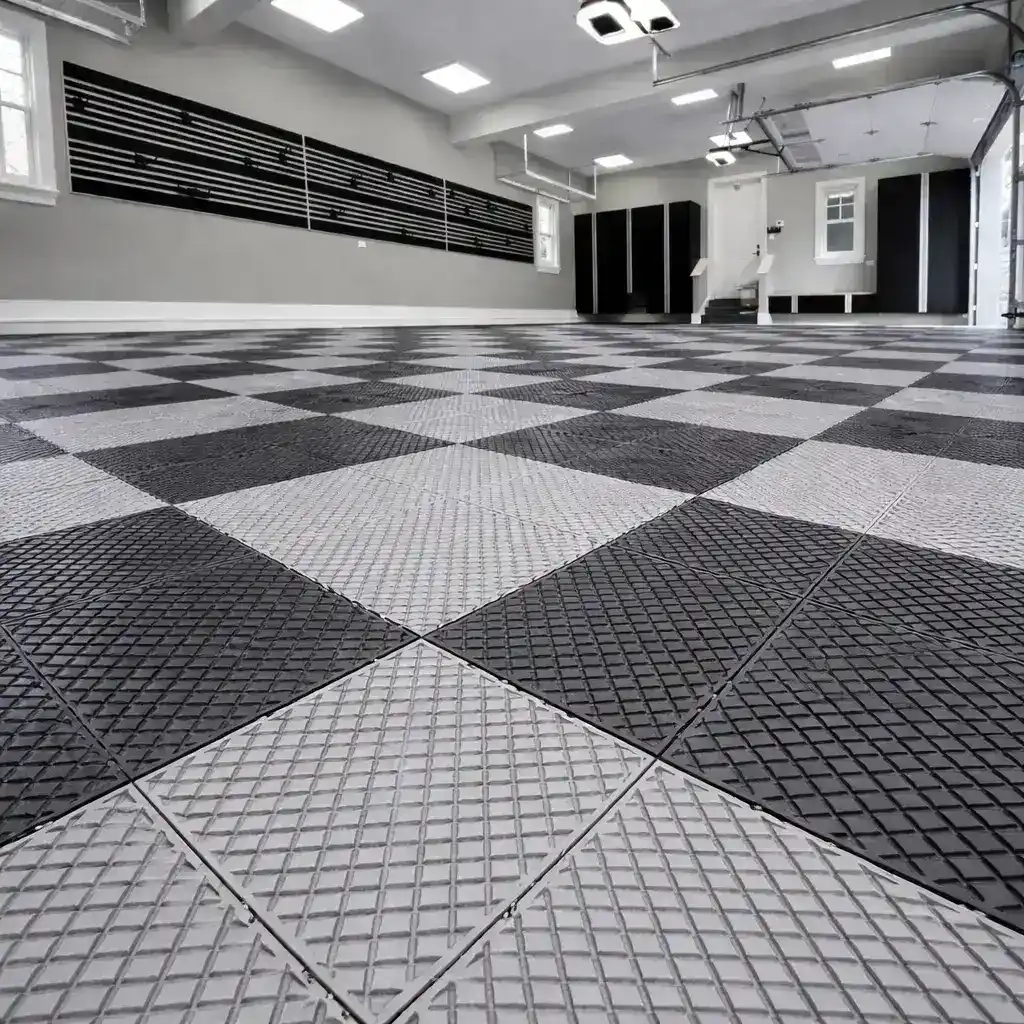
Black and light grey interlocking garage tiles laid to a diagonal checkerboard

Interlocking Garage Flooring in Dubai, Abu Dhabi & UAE

Interlocking garage flooring is a floor of rigid tiles that clip together over existing concrete, with no adhesive and no curing. Garage tiles take traffic the day they go down, and a damaged tile lifts out and is replaced on its own. We fit polypropylene, PVC and rubber tiles across Dubai, Abu Dhabi and all seven UAE emirates.

  • Fitting interlocking tiles in the UAE since 2014
  • All 7 emirates covered
  • Polypropylene, PVC and rubber tiles
  • Free site visit and layout plan
  • Single-tile replacement, no refinishing

Where tiles beat a coating, and where they do not

A clipped tile floor wins on two things a coating cannot match: it is finished the day it goes down, and one damaged tile comes out without touching the rest of the floor. It loses on one thing that matters just as much: it is not sealed to the slab, so anything spilled gets into the joints. That trade is the whole decision.

Tile surface texture and wet grip

Grip comes from the moulded surface rather than from an additive, so it varies by tile: a studded or coined top holds more than a smooth one. Water, oil and tyre dust reduce it on any floor. Which surface suits the bay is decided on the site visit.

How long interlocking tiles last in a UAE garage

Eight to fifteen years depending on the material and how much sun reaches the floor. Sun through an open door is what shortens it, because UV fades the pigment before the tile fails mechanically. A tile that does fail gets replaced on its own, so the floor ages tile by tile rather than all at once.

Garages, workshops and parking bays

Most of this work is villa and townhouse garages, where the floor goes down over a weekend with no disruption. Apartment basement parking is the next largest, laid in sections so bays stay usable. For a bay that is a workshop first, with lifts and standing fluids, see workshop flooring.

How a clipped tile floor works

A clipped tile floor is not glued down and not sealed. Each tile locks to its neighbours and the whole field floats on the slab as one sheet. Four things follow from that.

How a clipped joint carries load

A wheel never sits on one tile. The load goes into the tile beneath it, across the locking tabs into the tiles around it, and down into the slab. That is why a thin section takes a vehicle, and why the floor is only as good as the slab: tiles spread load, they do not bridge a void.

Edge trim and ramps at the threshold

Exposed edges are where a tile floor fails first. At a threshold a turning tyre catches a square edge and lifts it. A moulded ramp edge takes the tyre up onto the floor instead, and a trim strip finishes an open side. Cheap to specify, expensive to retrofit.

Expansion gap at the perimeter

Tiles grow and shrink with temperature, which in a Dubai garage means real movement between February and August. A small gap at the walls lets the field move without pushing itself up at the joints. A floor laid tight to the wall is the usual reason a tile floor buckles in summer.

Single-tile replacement

The one thing no coating offers. A stained, cracked or burnt tile unclips and a replacement goes in, with no refinishing and no colour-match problem if the spare came from the same batch. We keep matching tiles from past installations for that reason.

Polypropylene, PVC and rubber tiles we fit

Three materials in the same clipped format. The format behaves the same in all three, so the choice is about what the surface has to survive. The compounds belong to their own pages and the detail lives there.

Polypropylene tiles

The standard residential tile and the one most garage tile floors are made of. A rigid moulded plastic tile, usually ribbed or coined on top and open underneath so water and air pass beneath the floor. That open base is the point: a damp slab dries out rather than trapping moisture under the tile, which is why polypropylene suits a garage that gets hosed. It is the hardest of the three underfoot, the lightest to handle and the cheapest to cover a large bay with, and it scratches rather than dents. Colour choice is wide, which is what makes the layouts below possible.

PVC interlocking tiles

Harder and smoother than polypropylene, with a solid rather than open base, which makes them easier to wipe down and better where chemicals get spilled. Heavier to lay and less forgiving over an uneven slab. Drainage behaviour, chemical detail and the full specification are on PVC garage flooring.

Rubber interlocking tiles

The soft option. Dense rubber in the same clipped format, which absorbs impact and deadens noise in a way neither plastic tile can. It also absorbs spills rather than shedding them. Compounds, hardness and heat behaviour are on rubber garage flooring.

Interlocking tile materials, and which one fits your garage

The three materials diverge on how hard the surface is, how much noise it kills and what it costs. The table sets them against each other.

Polypropylene, PVC and rubber interlocking tiles compared.
CriterionPolypropylenePVC tilesRubber tiles
Price (AED/sqm)On the site visit50-130 AED/sqm55-250 AED/sqm
Material densityHard and rigid, open baseHard, smooth surfaceMedium, flexible
Sound dampeningFairFairExcellent
Foot comfortHardHardCushioned
Lifespan in UAE conditionsOn the site visit8-12 years10-15 years
Best forResidential garages, bays that get hosed, large areasAuto workshops, chemical zones, general purposeGyms, home workshops, heavy equipment
Read full specsYou are herePVC tilesRubber tiles

Comparing against other systems? The full comparison of all ten garage floor systems sets them side by side.

What the tile layout decides, and how we plan yours

A tile floor is laid to a plan, not poured to an edge. Where the first row starts fixes where the cut tiles end up, the colours have to be ordered before the first tile goes down, and the layout either follows the slab's existing fall or fights it. None of this can be settled from a photograph, which is why the site visit comes first.

Black and grey interlocking tiles running to a clean cut row against the garage walls

Tile direction and the perimeter cut

The run starts from the centre of the bay and works outward, not from a wall. That puts full tiles where they are seen and cut tiles against the walls, where a trim strip finishes them. Start from a wall and the cut row lands in the middle of the floor, in front of the car.

Yellow bay markings and numbers laid into a grey interlocking tile floor

Two-tone, borders and bay markings

This is the design question buyers actually ask. A contrasting border reads as a finished floor rather than a covered one. A checkerboard or two-tone diagonal breaks up a large bay. A marked-out parking bay, a walkway down one side or a contrasting pad under a workbench all come out of the same order. The pattern is decided before the tiles are ordered, because quantities per colour change with the design and a second order rarely matches the first batch.

Open-grid ventilated interlocking tiles that let water pass through to the slab below

Drainage direction and floor falls

Most garage slabs fall towards a drain or a door, and a tile floor follows that fall rather than levelling it. The run is set so water moves across the joints towards the fall instead of sitting against a cut edge. A slab falling the wrong way is a slab problem to solve first, not a pattern to design around.

Interlocking tiles cut around structural columns in a basement parking area

Columns, doors and obstacles

Columns, steps, drain covers and door tracks all need tiles cut to them, and a cut is tidier planned into the run than discovered halfway across. Ramp edges go at the threshold, trim at any open side. We mark these on the layout before the order.

Where interlocking tiles fall short in a UAE garage

Four things a tile floor does that a poured floor does not, and a buyer should hear them before the quote. The joints are the trade-off for being able to lift one tile out. They do not go away.

Liquids go through the joints

A clipped tile floor is not sealed. Fuel, oil, brake fluid and water pass between the tiles and reach the slab, where they sit until the floor is lifted. No tile material changes that, because the joints are the route. Where fluids are spilled regularly, a coating is the right answer and we will say so on the visit: epoxy garage flooring is where that starts.

The joints are visible and collect grit

A tile floor always reads as a tile floor. The grid is part of the look, and grit and dust settle into the joint lines, which shows most on a dark tile and least on a mid-tone or a pattern. Sweeping gets most of it. It never looks like a poured floor.

Tiles can lift at a threshold

A square edge at a door is the one place repeated turning tyres get under the floor and peel it. A moulded ramp edge prevents it, which is why the mechanics section treats edge trim as a specification item. Retrofitting after a lift means relaying the affected run.

A slab out of level shows through

Tiles follow the slab, they do not correct it. A dip stays a dip under the floor, and a bad one makes the joints work loose as the field flexes over it. Levelling first is a real line on the quote and skipping it is a false economy.

That is also the page's strongest argument, because single-tile replacement is the one thing no coating can offer.

What decides the cost of an interlocking tile floor

Three things move a tile quote and the slab is the one people do not expect.

The material sets the band

Polypropylene sits at the lower end, PVC above it, heavy-duty rubber higher again. The table shows the indicative band per material.

Thickness matters more than area

A thin residential tile and a heavy commercial one are the same format at very different prices, and the bay's use decides which is right.

The slab decides whether it works at all

Tiles need a reasonably level, clean, dry slab and no grinding, but a slab out of level needs attention first and that is a real line on the quote.

The layout changes the order

Quantities per colour come out of the pattern above, so a two-tone or bordered floor is priced from a plan rather than a square-metre figure.

What the free site visit measures

Slab level and moisture, the real area including thresholds and obstacles, the fall, how the bay is used, and the layout. That produces a written figure.

How we fit an interlocking tile floor, five stages

A tile floor is the fastest format we fit and the one where preparation is least visible in the result, which is why it gets skipped. Level and layout are settled before a tile is opened.

  1. Free site visit and tile recommendation. The measurements above, plus which material suits the bay. Written quote follows.
  2. Substrate cleaning and slab inspection. The slab swept and cleaned, then checked for level with a straightedge. Levelling compound where a dip needs it. No grinding, no primer.
  3. Layout and pattern plan. Set out as above: run direction, perimeter cut, pattern and colour quantities, the fall, and every obstacle marked before the order goes in.
  4. Snap-lock installation. Tiles laid from the centre outward and locked as they go, cut to walls, columns and thresholds, with the expansion gap held at the perimeter and ramp edges at the door.
  5. Alignment check and handover. Joints and edges checked across the field, ramps and trim secured, then the spare tiles and the maintenance note. The floor takes traffic immediately.

Interlocking tiles across the seven UAE emirates

We fit interlocking tile floors in all seven emirates.

Dubai and Abu Dhabi take most of the work, across villa garages, basement parking and commercial bays. Al Ain is covered as a city within Abu Dhabi emirate.

Sharjah, Ajman, Umm Al Quwain, Ras Al Khaimah and Fujairah are scheduled with other work in the emirate. Because tiles need no cure, an outer-emirate bay is usually finished in a single visit.

Interlocking garage tile questions UAE buyers ask

How does interlocking garage flooring compare to epoxy?

Tiles clip down with no adhesive and no cure, so the floor takes traffic the same day and a damaged tile lifts out on its own. Epoxy gives a continuous film that is harder and easier to wipe clean, but it needs grinding first and 24 to 72 hours to cure, and it cannot be repaired in sections.

Can interlocking garage flooring handle heavy vehicles like SUVs and trucks?

Yes. Heavy-duty polypropylene and rubber interlocking tiles take SUVs, pickups and light commercial vehicles in residential and parking use. The load goes through the clipped joints into the slab, so a sound slab matters as much as the tile. For forklifts and continuous machinery we specify an industrial-grade tile, confirmed on the site visit.

Do you offer free site inspection for interlocking projects in Dubai and Abu Dhabi?

Yes, free site inspections are available across all UAE emirates with no obligation. Same-day inspections are available in Dubai and Abu Dhabi, with scheduled visits within 24 to 48 hours for outer emirates. Our specialist evaluates substrate condition, traffic patterns, and your usage requirements before recommending the right interlocking tile system and providing a written quote.

How long does interlocking garage flooring installation take?

Most residential interlocking garage flooring installations complete in 1 to 2 days, depending on garage size and tile pattern complexity. Larger commercial parking facilities and industrial workshops typically require 3 to 7 days. Unlike epoxy systems, interlocking tiles need no curing time. Floor is ready for vehicle traffic immediately after installation completes.

Do you provide warranty on interlocking garage flooring?

Ask any installer what their workmanship cover actually includes for a tile floor, because the failure points are specific: lock-fit integrity, edge and ramp stability at the threshold, and tile colour hold under UV. Material cover passes through from the manufacturer. We confirm our terms in writing in the quote rather than on this page.

What maintenance does interlocking garage flooring need?

Minimal maintenance. Sweep regularly to remove debris and mop occasionally with neutral pH cleaner. Spills wipe clean from tile surfaces. Damaged or stained tiles can be replaced individually within minutes, no need to refinish or coat the entire floor. We stock matching tiles for past installations to support easy long-term maintenance.

What types of interlocking garage tiles are available?

Three materials. Polypropylene is the standard residential tile and this page covers it in full. PVC tiles are harder and smoother, better where chemicals are spilled, and are covered on the PVC page. Rubber tiles absorb impact and noise, and are covered on the rubber page. The site visit decides which suits your bay.

How much does interlocking garage flooring cost in Dubai and the UAE?

Three things move the number: the tile material, the tile thickness and the slab underneath. Polypropylene sits at the lower end, PVC above it, and heavy-duty rubber higher again. A slab that is out of level needs attention first. The comparison table shows the indicative band, and the free site visit produces a written figure.