
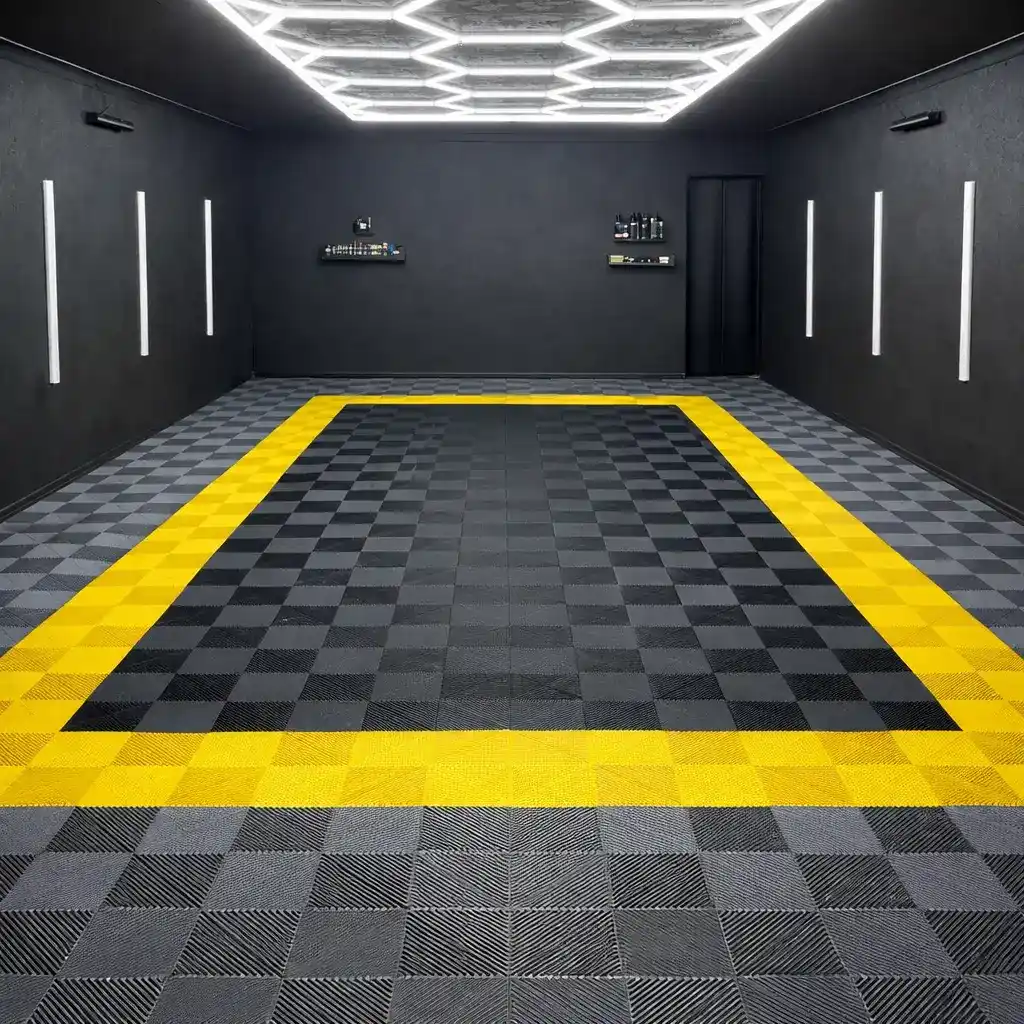
Grey checkered PVC garage tile floor finished with a yellow perimeter border

PVC Garage Flooring in Dubai, Abu Dhabi & UAE

PVC garage flooring is a floor of rigid polyvinyl tiles or bonded rolls laid over existing concrete, sold by some suppliers as vinyl garage tiles. The surface is hard and non-porous, so it wipes clean rather than absorbing. Loose-lay tiles take traffic the day they go down. We fit it across Dubai, Abu Dhabi and all seven UAE emirates.

  • Fitting PVC garage floors in the UAE since 2014
  • All 7 emirates covered
  • Tiles, interlocking and heat-welded rolls
  • Free site visit before any quote
  • Single-tile replacement, no refinishing

Where PVC beats a coating, and where it does not

PVC is the easiest garage floor to clean and the least comfortable to stand on, and both of those follow from the same property: the surface is hard and non-porous, so nothing soaks into it and nothing gives underfoot. That makes it the right floor for a bay that gets dirty and the wrong one for a bench you stand at all day. It also goes down over an existing slab with no grinding, which is the practical reason it wins work from coatings.

Water, chemicals and what PVC actually resists

PVC is non-porous, so water, oil and the usual garage fluids sit on the surface and wipe off instead of soaking in. That is a property of the material, not a test result, and it is where most suppliers overclaim. What a coating is resistant to, and for how long, is a question for the manufacturer's data sheet: ask which liquids it was tested against and for what exposure time, because resisting water says nothing about resisting brake fluid or a solvent left overnight. We hold no test document in any standard's name for our own floors.

PVC surface texture and wet grip

Grip on PVC comes from the moulded surface, and smooth PVC is the slipperiest tile we fit when it is wet. Studded, coined and ribbed surfaces hold more. Water, oil and tyre dust reduce grip on any floor, so the surface that suits the bay is chosen on the site visit rather than from a brochure.

Moisture in the slab, and why it matters

This is the one check that decides whether a bonded PVC floor lasts, and almost nobody asks about it. Moisture rising through a slab turns into vapour pressure under a sealed floor and pushes it up from below, which is the most common way an adhesive-bonded PVC floor fails. The slab is tested before any adhesive goes down and has to read below 4% moisture content. A slab that fails goes loose-lay or gets a barrier first.

How long PVC tiles last in a UAE garage

Eight to twelve years on a sound, dry slab, which is the range the table states against UAE garage use. Adhesive-bonded and heat-welded formats reach the upper end because there are no loose edges to lift. Direct sun fades the colour before the tile fails mechanically, and a faded or damaged tile is replaced on its own.

Villas, car washes and workshops

Most of this work is villa and apartment garages, where the attraction is a floor that goes down without the garage being out of use for a cure. Car wash bays and commercial parking take the heat-welded roll, because standing water is the whole problem there. For a bay that is a workshop first, with lifts and point loads, see workshop flooring.

PVC garage floor formats we install

Three formats, and the choice is mostly about whether the floor needs to be sealed against standing water or liftable. PVC tiles are sold as vinyl garage tiles by some suppliers; it is the same material under both names.

Black and grey PVC garage floor tiles laid in a square grid across a workshop bay

PVC garage floor tiles

The standard format. Rigid tiles in 50cm or 1m squares, 6 to 10mm thick, laid loose or bonded with adhesive. Loose-lay takes traffic immediately and lifts out again; bonded is walkable in four hours and takes a vehicle after 24. Thinner tiles suit a domestic bay, thicker ones a bay with a trolley or a jack in it.

Red and black interlocking PVC tiles clipped together across a garage floor

Interlocking PVC tiles

Heavy-duty 50cm tiles, 7 to 12mm thick, with snap-lock edges that hold the field together without adhesive. In PVC the compound is harder and smoother than rubber, so the lock holds well and the surface stays easy to wipe. Locking geometry, load across a clipped joint, edge trim and single-tile replacement are covered on interlocking garage flooring.

PVC roll flooring laid as one continuous grey surface with no visible joints

PVC roll flooring

PVC supplied in 2m widths, 2 to 4mm thick, bonded with full-spread adhesive and finished with heat-welded or solvent-bonded seams. The seams are the point: a heat-welded seam fuses the sheets into one continuous water-tight surface, which no tile floor can do, and that is what makes it the format for car wash bays and basement parking. It needs a slab that passes the moisture test and 24 hours for the seams to cure before vehicles.

PVC vs rubber tiles: which suits your garage?

PVC and rubber are the two tile materials we fit and they fail in opposite directions. PVC wipes clean and is hard underfoot; rubber absorbs impact and noise but marks under fuel. The table sets them against each other, and the figures in it match the rubber page's own table, which they must.

PVC tiles against rubber tiles, criterion by criterion.
CriterionPVC tilesRubber tiles
Price (AED/sqm)50-130 AED/sqm55-250 AED/sqm
Density and hardnessHard, smooth surfaceMedium, flexible
Hot tyre pickup resistanceGoodExcellent
Sound dampeningFairExcellent
Foot comfort standing all dayHardCushioned
Tile edge profileSharp, definedSoft-edge, flexible
Lifespan in UAE conditions8-12 years10-15 years
When to choose PVC
  • Auto repair workshops with frequent oil and chemical spills
  • Heavy chemical exposure: brake fluid, petrol, solvents
  • A hard surface for rolling toolboxes and equipment carts
  • Lower budget priority
When rubber tiles are better
  • Home gyms with heavy weights and sound concerns
  • Workshops requiring foot comfort for long shifts
  • Equipment drop protection priority
  • Sound dampening required, apartment or attached garages
Read full specsYou are hererubber garage flooring

Comparing against other systems? The full comparison of all ten garage floor systems sets them side by side.

Where PVC garage flooring falls short

Four things PVC does badly, and a buyer should hear them before the quote. PVC is the easiest garage floor to clean and the least comfortable to stand on. Both are true at once.

Hot tyres can mark it

A tyre that has been on Dubai tarmac holds heat long after the car is parked, and PVC softens under sustained heat more readily than rubber does. On a thin tile that can leave a visible mark or a depression where the tyre sat. A thicker tile resists it better and a rubber bay better still, and we will say which on the visit. No tile is immune to it.

It is hard underfoot

Standing at a bench for a shift on PVC is uncomfortable, and no thickness of PVC changes that because the hardness is the material. That is what the foot comfort row in the table is for. A rubber bay under the bench and PVC across the rest of the floor is a common and sensible split.

Solvents attack the surface

Water and oil are fine. Acetone, thinners, brake cleaner and strong solvents are not: they soften and dull the surface, and on bonded formats they can reach the adhesive. Bleach, ammonia and abrasives do the same more slowly. Where solvents are used daily, a resin coating is the better floor.

A loose-lay tile floor is not sealed

Loose-lay and interlocking tiles have open joints, so water and fluids pass between them and reach the slab, where they sit until the floor is lifted. Only the heat-welded roll above is continuous. On a floor that has to stay clean down to the concrete, say so on the visit and we will quote the roll or send you to epoxy garage flooring.

What decides the cost of a PVC garage floor

Four things move a PVC quote and the slab is the one that surprises people.

The format sets the band

Loose-lay tiles sit at the lower end, interlocking above them, and heat-welded roll highest, because welding seams is skilled labour rather than material cost. The table shows the indicative band.

Thickness is specified, not chosen

Six to ten millimetres covers a domestic bay; twelve is for trolleys, jacks and continuous traffic. Paying for thickness a bay does not need is waste, and saving on thickness a bay does need shows up as marks within a year.

The slab decides whether it works

PVC needs no grinding, which is most of why it undercuts a coating. But it does need a level slab, cracks over 3mm filled, and a moisture reading below 4% for any bonded format. A slab that fails goes loose-lay or gets a barrier, and either way that is a line on the quote.

What the free site visit measures

Slab level, crack condition and a moisture test, the real area including thresholds, how the bay is used and what gets spilled in it, and whether a sealed or liftable floor is the right answer. That produces a written figure.

How we install a PVC garage floor, five stages

The stage that decides a PVC floor is the moisture test, because the most common PVC failure is not wear. It is a bonded floor lifting off a damp slab.

  1. Free site visit and format recommendation. The measurements above, plus which format suits the bay. Written quote follows.
  2. Material delivery and acclimatisation. Tiles, planks and interlocking arrive 24 to 48 hours before fitting and sit in your garage to reach the temperature they will live at. Roll flooring is delivered on the day and acclimatised on site. Skipping this is why floors push at the joints a month later.
  3. Slab cleaning and moisture test. Mechanically cleaned, cracks deeper than 3mm repaired, then tested for moisture content, which must read below 4% for any adhesive-bonded format. This is the step that prevents adhesive failure from vapour pressure.
  4. Installation by format. Loose-lay tiles laid from the centre outward. Bonded tiles and planks set into full-spread adhesive. Interlocking clipped and cut to walls and thresholds. Roll flooring bonded and the seams heat-welded.
  5. Final walk-through and handover. Joints, edges and seams checked, then the spare material and the cure note: loose-lay takes traffic immediately, bonded tiles are walkable in four hours and vehicle-ready in 24, and heat-welded seams need 24 hours before vehicles.

PVC garage flooring across the seven UAE emirates

We fit PVC garage floors in all seven emirates.

Dubai and Abu Dhabi take most of the work, across villa garages, apartment parking, car wash bays and light industrial units. Al Ain is covered as a city within Abu Dhabi emirate.

Sharjah, Ajman, Umm Al Quwain, Ras Al Khaimah and Fujairah are scheduled with other work in the emirate, and because the material has to acclimatise anyway, the delivery and the fitting visit are planned as two trips rather than one.

PVC garage flooring questions UAE buyers ask

How much does PVC garage flooring cost in Dubai and the UAE?

Three things move the number: the format, the tile thickness and the slab. Loose-lay tiles sit at the lower end, interlocking above them, and heat-welded rolls highest because the seam work is skilled labour. A slab that fails the moisture test needs attention first. The table shows the indicative band and the site visit produces a written figure.

How long does PVC garage flooring last in UAE conditions?

Eight to twelve years in a UAE garage on a sound, dry slab, which is the range the table shows. Adhesive-bonded and heat-welded formats reach the upper end because there are no loose edges to lift. Direct sun fades the colour before the tile fails, and a damaged tile is replaced on its own.

Is PVC garage flooring waterproof and suitable for basement parking?

It depends on the format, and the distinction matters. Heat-welded PVC roll has its seams fused into a continuous water-tight surface, which is why it suits basement parking and car wash bays. Loose-lay and interlocking tiles are not sealed: water passes between them to the slab. Tell us which the bay needs.

PVC vs epoxy vs rubber garage flooring, which is right for my garage?

PVC has a hard, non-porous surface that wipes clean, and it is unforgiving to stand on. Rubber absorbs impact and noise but marks under fuel. Epoxy gives a continuous film bonded to the slab, which no tile does, but it needs grinding and up to 72 hours of cure. Workshop, PVC. Gym bay, rubber. Sealed floor, epoxy.

How long does PVC garage flooring installation take?

Acclimatisation comes first: tiles and planks arrive 24 to 48 hours before fitting so they settle to your garage temperature. Fitting then takes one to two days for most residential bays. Adhesive-bonded tiles are walkable in four hours and take a vehicle after 24. Heat-welded rolls need 24 hours for the seams to cure.

How do you clean and maintain PVC garage flooring?

Sweep, then mop with warm water and a neutral pH cleaner. The surface is non-porous, so spills sit on top and wipe off rather than soaking in. Keep bleach, ammonia, abrasives and solvent-based products off it: they attack the surface and weaken adhesive bonds. A marked tile is replaced rather than refinished.

Can PVC garage flooring handle heavy vehicles like SUVs and trucks?

Cars, SUVs and light commercial vehicles are routine on 6 to 10mm tiles over a sound slab. For forklifts, delivery trucks and standing machinery we specify 12mm interlocking or full-spread adhesive roll, because continuous point loading is what lifts a thinner tile. The slab matters as much as the thickness.

What should I ask about the warranty on a PVC floor?

Ask what the workmanship cover actually includes, because PVC fails in specific ways: edge lifting, tile separation, seam de-bonding on adhesive formats, colour fading under UV, and adhesive bubbling from slab moisture. Ask which of those are covered and for how long. Material cover passes through from the manufacturer.