
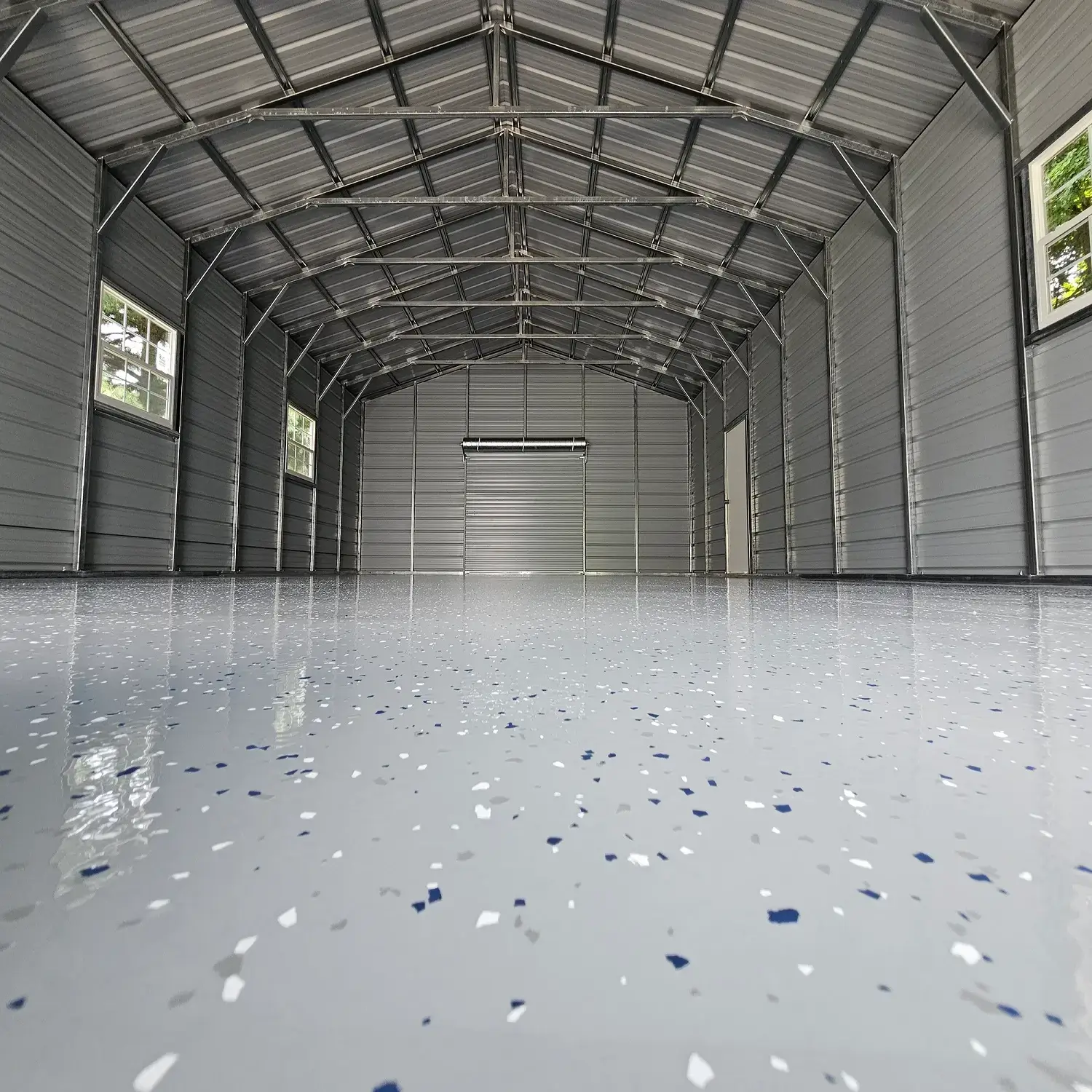
Light grey epoxy garage floor in a large garage interior with high ceilings

Epoxy Garage Flooring in Dubai, Abu Dhabi & UAE

Epoxy garage flooring is a two-part resin coating that bonds chemically to a prepared concrete slab, so it becomes part of the floor rather than a covering laid on top. That bond is what decides how long it lasts: on a diamond-ground and primed slab an epoxy garage floor runs for years, and on a smooth or contaminated one it lifts.

  • Installing across the UAE since 2014
  • All 7 emirates covered
  • Five epoxy build options
  • Free site visit and slab assessment
  • Same-day response in Dubai and Abu Dhabi

What is epoxy garage flooring, and where does it suit?

Epoxy suits a garage that is parked in rather than worked in, on a slab sound enough to grind and prime. It is the lowest-cost way to get a hard, jointless, washable floor over concrete, and it is the wrong answer for a bay in direct sun all day or one that cannot be taken out of use while the resin cures. The three spaces below cover most of what we fit.

Glossy grey epoxy floor in a residential villa garage with a car and fitted cabinets

Residential villa and townhouse garages

The common case. A single or double bay that is parked in daily, swept rather than hosed, and expected to look tidy. Solid colour epoxy over a ground and primed slab covers it, and the cure period is the only real disruption.

Speckled epoxy floor in a multi-bay commercial parking garage

Commercial and basement parking bays

Tenant and visitor parking, where traffic volume and the sequence of works matter more than the finish. These are laid in sections so part of the park stays open, with bay lines reinstated over the new floor and fall to the existing drains kept.

White epoxy floor in a bright automotive workshop with vehicle lifts

Workshops and industrial bays

Where a vehicle is worked on rather than parked, the build gets thicker and the grip goes up, because the floor sees jack feet, dropped tools and standing fluids. Specified per bay. See workshop flooring for the heavier systems.

Lifespan on a ground and primed slab

Ten to fifteen years is the normal range for a properly installed epoxy garage floor in UAE conditions, and the condition in that sentence is doing the work. Installations that skip mechanical grinding typically fail within 6 to 18 months, which is the single biggest difference between two quotes that look alike.

Cleaning and day-to-day upkeep

A cured epoxy floor is jointless and non-porous, so it sweeps and mops rather than absorbing. Neutral pH cleaner, no sealing and no recoating in normal use. Oil and brake fluid are wiped rather than left to stand, which is a habit rather than a limitation.

Epoxy build options we install in UAE garages

Five builds, from the thinnest to the thickest. The difference between them is how much resin goes down and what is broadcast into it, and that decides both the cost and what the floor will take.

Solid colour epoxy coating

The standard residential build and the one most quotes mean by "epoxy garage floor coating". A pigmented two-part resin rolled over a primed slab in a single colour. Lowest entry cost of the five, simple to clean, and smooth, which is why grip is specified separately where a bay gets wet.

Clear epoxy coating

An unpigmented coat that seals and protects the slab while leaving it visible. Chosen where the concrete itself is the finish, or over a decorative broadcast as the protective layer. It shows every mark in the slab beneath it, which is the point and also the risk.

Stone-textured epoxy

Natural stone, quartz or pebble aggregate bonded in resin to give a profiled surface with texture underfoot. Suits semi-outdoor bays, driveway aprons and ramps where a smooth floor would be the wrong choice. Harder to sweep than a flat coating, which is the trade.

Self-levelling epoxy

A thick, flowing build that finds its own level and fills minor undulation in the slab. The workshop and point-load option: jack feet, trolley legs and dropped tools. Costs more because the material depth is greater and the slab preparation has to be better, not worse.

Epoxy floor paint

The budget option, named here so it can be ruled out. A one-part paint rolled onto concrete with little or no preparation. It is far less durable than a resin system and wears faster under tyres, often within a year or two. On a sound slab with a tight budget it is honest; it is not a resin floor.

Where grip is wanted as standard rather than added, a flake broadcast is the usual answer: garage flakes flooring.

Where the floor is a display finish for a showroom or a collection: metallic epoxy garage flooring.

Epoxy, polyurethane or polyurea: which suits your garage?

The three resin families differ on four things that matter to a buyer: how fast they cure, how they behave in direct sun, how they take a hot tyre, and what they cost. Epoxy is the hardest and the cheapest, polyurethane is the more flexible and the more UV-stable, and polyurea cures fastest. The table sets them side by side.

Three resin families compared. Indicative figures for UAE conditions; your bay is specified on the free site visit.
CriterionEpoxy, entry tierPolyurethane, premium tierPolyurea, fast-cure premium
Price (AED/sqm)65-250 AED/sqm95-200 AED/sqm120-280 AED/sqm
Cure to vehicle traffic5 to 7 days3 to 5 days24 to 48 hours
Hot tyre pickup resistanceGoodExcellentExcellent
UV stability in direct UAE sunFairExcellentExcellent
Surface flexibilityFair, rigidGoodExcellent
Lifespan in UAE conditions10 to 15 years18 to 22 years20 to 25 years
Best forResidential garages, budget priority, mild trafficDirect sun exposure, active garages, longevity priority24/7 operations, fleet bays, fastest cure needs
Read full specsThis pagePolyurethane garage flooringPolyurea garage coating

Still choosing between systems? The full comparison of all ten garage floor systems sets them side by side.

Where epoxy garage floors fail, and what prevents it

Epoxy has four failure modes and three of them are decided before any resin is mixed.

Hot tyre pickup, and which builds resist it

A tyre that has been on Dubai tarmac stays hot long after the car is parked, and where a coating is thin, badly bonded or driven on before it has cured, that heat softens the film and the tyre lifts it away as the car pulls out. A full-thickness build on a diamond-ground slab, correctly primed and left to cure, resists it. A thin paint film does not. Polyurethane and polyurea resist it better than standard epoxy. No coating is immune to it.

Delamination when the bond fails

This is the page's central point. Epoxy does not sit on concrete, it bonds to it, and a bond to a smooth, dusty or oil-soaked surface is not a bond. A floor that was never properly ground will lift in sheets regardless of how good the resin was. The grinding and priming stage below is what prevents it.

Slip when the floor is wet

Oil, water and tyre dust can make a smooth epoxy floor slippery, so we add anti-slip aggregate or a flake broadcast to give grip where it is needed. The level is set on the site visit rather than chosen from a list, because a workshop bay that gets washed down needs more grip than a dry villa garage, and too much texture makes a floor harder to sweep.

Direct sun, ambering and chalking

Standard epoxy ambers and chalks where strong sunlight reaches it, which happens in any bay with the door open through the day, on a ramp, or in a semi-outdoor space. Polyurethane garage flooring and aliphatic polyurea hold their colour better under UV.

What decides the cost of an epoxy garage floor

The honest answer is that the slab decides more than the epoxy does, and that is why a price given over the phone is a guess.

The slab is the variable

A sound, clean slab needs diamond grinding and a primer, and that is the cheap end. A slab that has been parked on for years usually needs more: oil ground out of the surface, cracks and spalling repaired, and a barrier primer where moisture is rising through the concrete. That preparation can exceed the cost of the coating itself, and it is the stage that decides whether the floor lasts, so it is the wrong place to economise.

The build changes the band

A thin solid colour coat and a self-levelling workshop build are different quantities of material and different numbers of days on site. The five builds above are set out in order of depth.

Area alone gives no figure

Two garages of the same size price differently if one has a drain to fall to, a step at the threshold, a column to cut around, or a door that has to stay usable while the resin cures. Edge work and detailing is where the hours go.

What the free site visit measures

Slab condition and moisture readings, the real area including edges and thresholds, how the bay is used, sun exposure through the opening, and whether the garage can be out of use for the cure. That produces a written figure rather than a range.

When epoxy is the wrong choice, and what we fit instead

Five situations where we would quote something other than epoxy.

A bay in direct sun all day

Standard epoxy ambers and chalks under sustained UV, and no topcoat schedule changes that enough to recommend it for an exposed ramp or an open-fronted bay. Polyurethane garage flooring holds colour and is the better spend there.

A garage that cannot be out of use

Epoxy needs a cure period before a vehicle goes on it and there is no safe way to shorten it. Where the car has to be back in by tomorrow, polyurea garage coating returns the bay to use in about 24 hours.

A floor that needs grip as standard

On epoxy, grip is an addition. Where texture is the requirement rather than an option, a flake broadcast builds it into the system instead of onto it.

An oil-soaked slab

Oil driven into concrete has to be ground out and sealed before any resin bonds, and where the contamination is too deep for that, a coating is the wrong product however good it is. The preparation stage below is where this is settled.

A tight budget on a sound slab

Epoxy floor paint is the honest cheap option and it stays in the build list for that reason. It is far less durable than a resin system and wears faster under tyres, so the better advice is usually to wait and do it once.

How we install an epoxy garage floor, five stages

Most failed epoxy floors trace back to the second stage rather than the resin. Grinding and priming are what the bond depends on, and a bonded floor on a well-prepared slab outlasts a better product laid on a dusty one. The second stage takes the longest and it is the one a cheap quote shortens.

  1. Free site inspection and material selection. Slab condition, moisture readings, real area, how the bay is used and sun exposure through the opening. Same day in Dubai and Abu Dhabi, scheduled within 24 to 48 hours elsewhere. Written quote within 24 hours.
  2. Substrate grinding and preparation. Diamond grinding to open the concrete and remove laitance, dust extraction, and degreasing where oil has soaked in. This is the stage the bond depends on.
  3. Crack repair and moisture mitigation. Structural cracks repaired with resin injection, spalling filled, and a barrier primer where humidity readings call for one. Most quotes leave this out, which is why most comparisons are not comparing the same job.
  4. Epoxy system application. The chosen build laid to the manufacturer's mixing ratios, thickness and coat timing, with grip level set as specified on the visit.
  5. Curing and quality handover. Coverage, thickness and edge detailing checked, then cure time confirmed in writing before vehicle traffic: 24 to 72 hours for epoxy. Plus how to clean it and what to keep off it.

Epoxy garage flooring across Dubai, Abu Dhabi and the UAE

We lay epoxy garage floors across every UAE emirate.

Dubai and Abu Dhabi carry same-day site inspection and take most of the work, split between villa garages, basement parking in apartment buildings and commercial workshops. Al Ain is covered as a city within Abu Dhabi emirate.

Sharjah, Ajman, Umm Al Quwain, Ras Al Khaimah and Fujairah are scheduled within 24 to 48 hours rather than same day, because the visit is routed with other work in the emirate.

Epoxy garage flooring questions UAE buyers ask

What is the difference between epoxy and polyurethane garage flooring?

Epoxy is harder and typically less expensive, which suits an indoor garage with moderate traffic. Polyurethane is more flexible and more UV-stable, so it handles direct sun and temperature swings better. Many UAE installations use a polyurethane topcoat over an epoxy base. Resistance to any specific fluid is a data-sheet question.

How long does epoxy garage flooring last in UAE conditions?

Properly installed epoxy garage flooring lasts 10 to 15 years or more in UAE conditions. Lifespan depends on how well the slab was ground and primed, on traffic load and on maintenance. Installations that skip mechanical grinding typically fail within 6 to 18 months.

Is epoxy garage flooring suitable for UAE heat and summer conditions?

Surface temperatures above 50°C and big seasonal swings are what a UAE garage floor has to take, and standard epoxy handles them indoors. In direct sun it ambers and chalks over time, so an exposed bay or ramp is better with a polyurethane topcoat over the epoxy base.

How long does epoxy installation take, and when can I park on it?

Most residential epoxy garage floors are finished in one to three days, depending on how much grinding and crack repair the slab needs. Larger commercial and industrial jobs run five to ten days. Epoxy then needs 24 to 72 hours of cure before a vehicle goes on it.

Can epoxy be applied over existing concrete, or does the slab need replacement?

In most cases, existing concrete can be coated successfully without replacement. Our team mechanically grinds the surface, repairs structural cracks with epoxy resin injection, and applies moisture barriers if humidity readings exceed acceptable thresholds. Only severely damaged or structurally compromised slabs need replacement, which we identify during the free site inspection before any quote is issued.

Is epoxy garage flooring slippery in wet or oily conditions?

Standard epoxy can be slippery when wet or contaminated with oil, so we add anti-slip aggregate or a flake broadcast to give grip where it is needed. The level is set on the site visit, because a bay that gets washed down needs more grip than a dry villa garage.

What should I ask an applicator before accepting an epoxy quote?

Ask for the pull-off adhesion figure on the system's data sheet, and ask what slab preparation it was achieved on. A high figure from a diamond-ground slab says nothing about a painted-over one. Then ask which liquids the coating was tested against and for how long.

Does epoxy work in a workshop or only a domestic garage?

Yes. A workshop bay takes a thicker build, usually self-levelling epoxy or an aggregate broadcast, because it sees point loads from jacks and trolleys and standing fluids. A domestic garage rarely needs that depth. Workshop floors are specified per bay, with grip and fall to drain set on site.